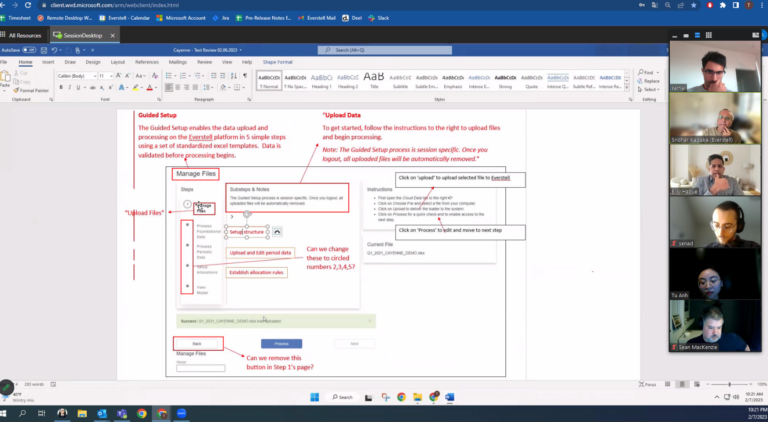

• Unclear onboarding process with no visual steps or progress indicators to guide users through setup
• Rigid workflow navigation, preventing users from moving back to previous steps without restarting the entire process
• Frequent upload errors with little guidance on how to resolve them
• Dependence on IT support whenever users encountered validation issues or missing data
• Repetitive document uploads, requiring users to upload files across multiple screens instead of managing them in one place
• Tedious document management, often forcing users to download and re-upload files during different steps
• Outdated visual design, lacking strong branding, hierarchy, and the level of trust expected from a financial platform
• Poor information hierarchy, making it difficult for users to interpret data quickly
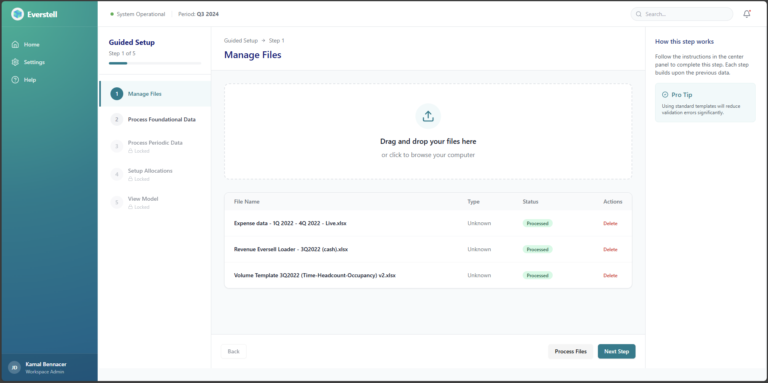
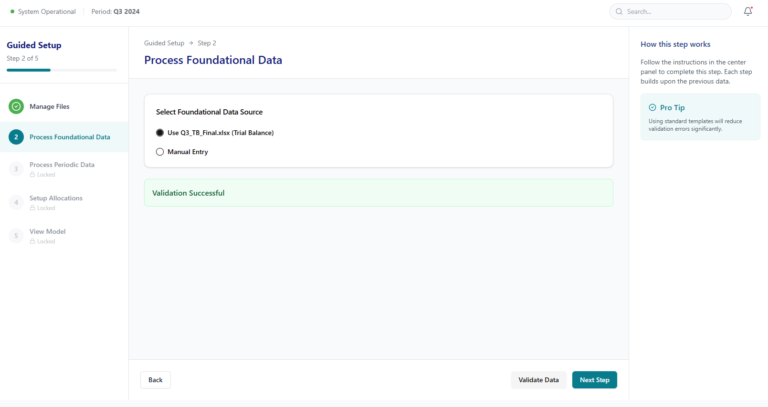
• Guided onboarding flow structured into five clear steps with visible progress indicators
• Flexible navigation allowing users to move forward and backward between steps without restarting the process
• Centralized document management through a master file upload page
• Drag-and-drop file uploads enabling users to upload multiple documents quickly
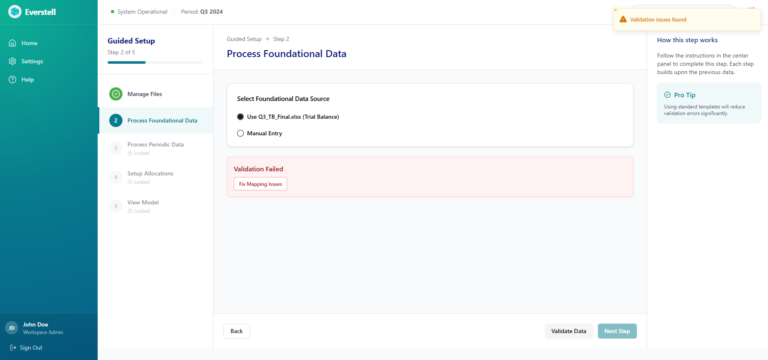
• Automatic error detection allowing users to identify and correct issues without contacting IT support
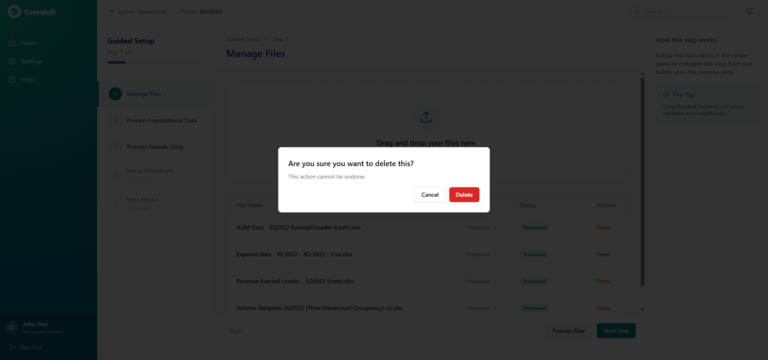
• Editable file management, allowing users to replace, remove, or update documents without restarting onboarding
• Modern fintech visual redesign introducing stronger branding, clearer hierarchy, and improved trust
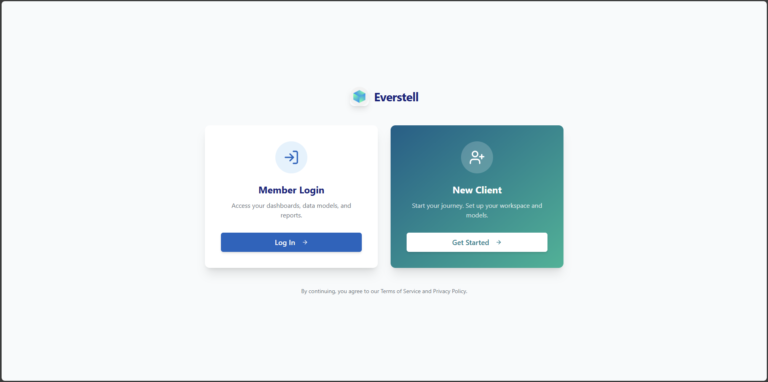
• Dedicated entry points for new clients and existing members to streamline navigation within the platform
Everstell is a financial modeling platform used by enterprise finance teams to manage allocations across entities, cost centers, and funds. The platform supports organizations managing $100B+ in assets under management (AUM), where accuracy, reliability, and clarity are critical.
Founded by CPAs with 40+ years of combined experience, Everstell brings deep domain knowledge to complex financial workflows and reporting systems.
Despite the platform’s powerful capabilities, the onboarding experience created significant friction. Finance teams had to upload multiple documents, configure allocation rules, and resolve validation issues before accessing the platform’s insights.
The workflow was fragmented, repetitive, and difficult to navigate, slowing down onboarding and increasing dependency on support.
This redesign focused on transforming onboarding into a guided, structured product experience that helps finance teams complete setup faster and reach valuable financial insights with confidence.
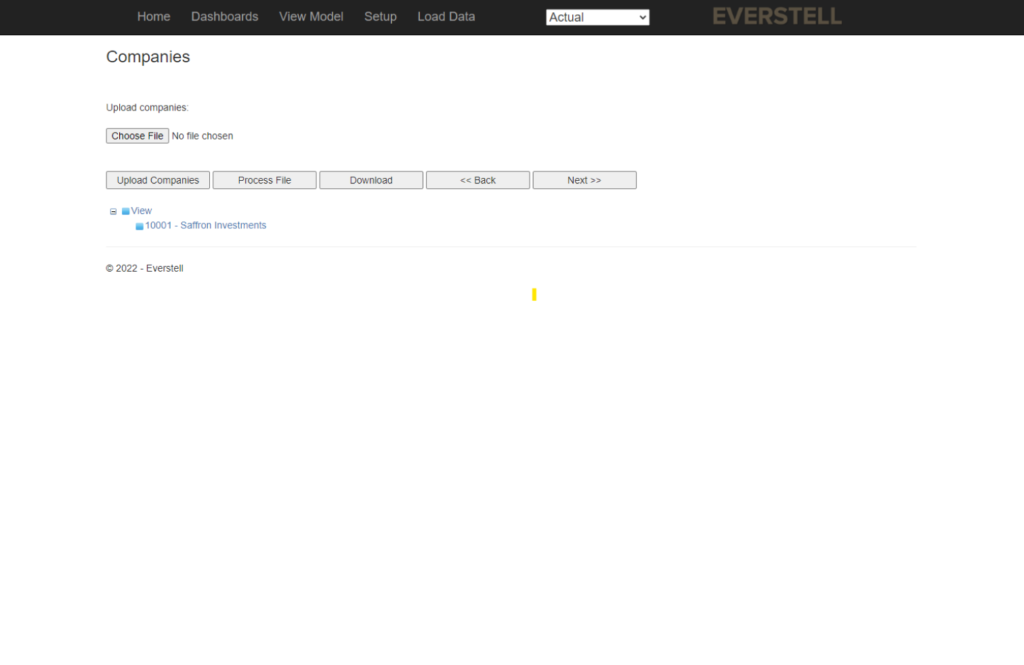
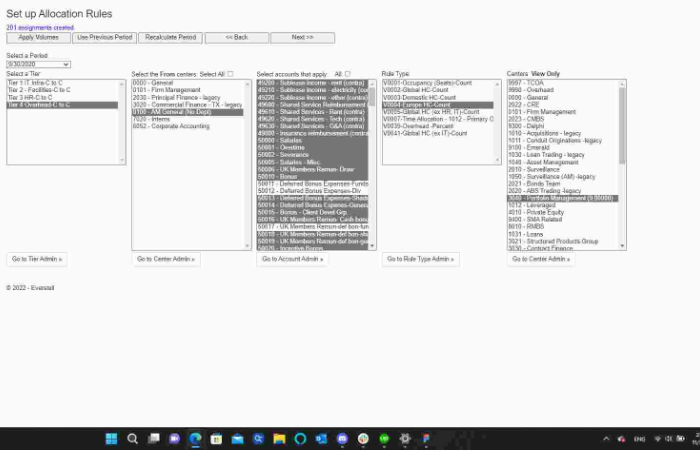
Manual selection for each item — users had to check every cost center individually, making it easy to miss entries and introduce allocation errors
Error-prone manual workflow — selecting cost centers one by one increased the risk of missing items and led to inaccurate allocations
No bulk selection — required manual checking of each cost center, making the process slow and prone to mistakes
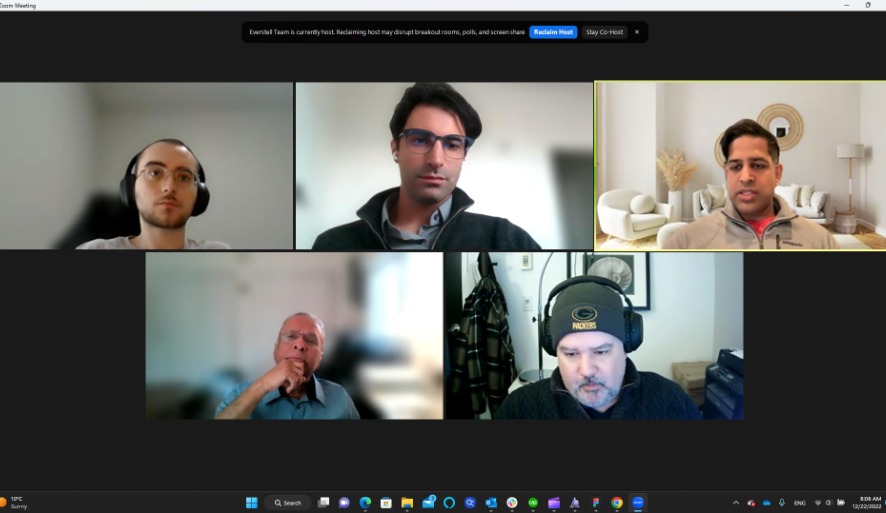
Rather than reinventing patterns, I wanted to understand how the best enterprise platforms handle complex workflows. My goal was simple: learn from systems that already work at scale.
These SaaS niche products are not simply found with just a Google search.
I joined these calls as a potential customer, observing how these platforms approached:
• onboarding experiences
• document management workflows
• dashboard hierarchy
• navigation systems
• error handling and validation
Initially, there was hesitation about conducting direct user interviews. Some stakeholders were concerned that exposing the product’s weaknesses might create unnecessary friction with clients.
To address this, I reframed the interviews as an opportunity to improve the next evolution of the product, focusing on workflow efficiency and future improvements rather than criticism of the current system.
Current users:
• CFOs
• Asset Managers
The challenge was not to redesign the UI.
It was to redesign the onboarding process itself.
Because the change impacted both product direction and engineering implementation, I brought engineers into the discussion early to ensure feasibility and shared understanding.
Together we reviewed:
• Research insights and user pain points
• The proposed onboarding workflow changes
• Technical constraints and system dependencies
• Opportunities to simplify validation and document handling
Increase the percentage of users who successfully complete the onboarding process and reach the dashboard without abandoning the setup flow.
Reduce the amount of time required for users to upload documents, configure required data, and finish the onboarding process.
Lower the frequency of errors during document uploads and data validation to minimize user frustration and workflow interruptions.
Decrease the number of cases where users must contact IT support to resolve onboarding issues.
Reduce the time it takes for users to complete onboarding and access meaningful financial insights on the dashboard.
Increase users’ sense of clarity and control while completing onboarding.
Two weekly Zoom meetings with the full team ensured alignment on product direction, design progress, and development priorities.
Short daily touchpoints with developers helped address technical questions quickly and maintain momentum during implementation.
Regular one-on-one meetings ensured UX decisions remained aligned with product and business goals.
Close collaboration with other designers helped refine interaction patterns and maintain consistency across the product.
Replaced multi-step upload actions with a single interaction to reduce friction and enable bulk uploads
Removed redundant steps (choose file → upload → process) into a streamlined interaction
Introduced step visibility to help users understand progress and navigate the onboarding flow
Replaced top navigation with a vertical sidebar to improve scalability, accessibility, and consistency across the platform
Replaced multi-step upload actions with a single interaction to reduce friction and enable bulk uploads
Removed redundant steps (choose file → upload → process) into a streamlined interaction
Introduced step visibility to help users understand progress and navigate the onboarding flow
Replaced top navigation with a vertical sidebar to improve scalability, accessibility, and consistency across the platform
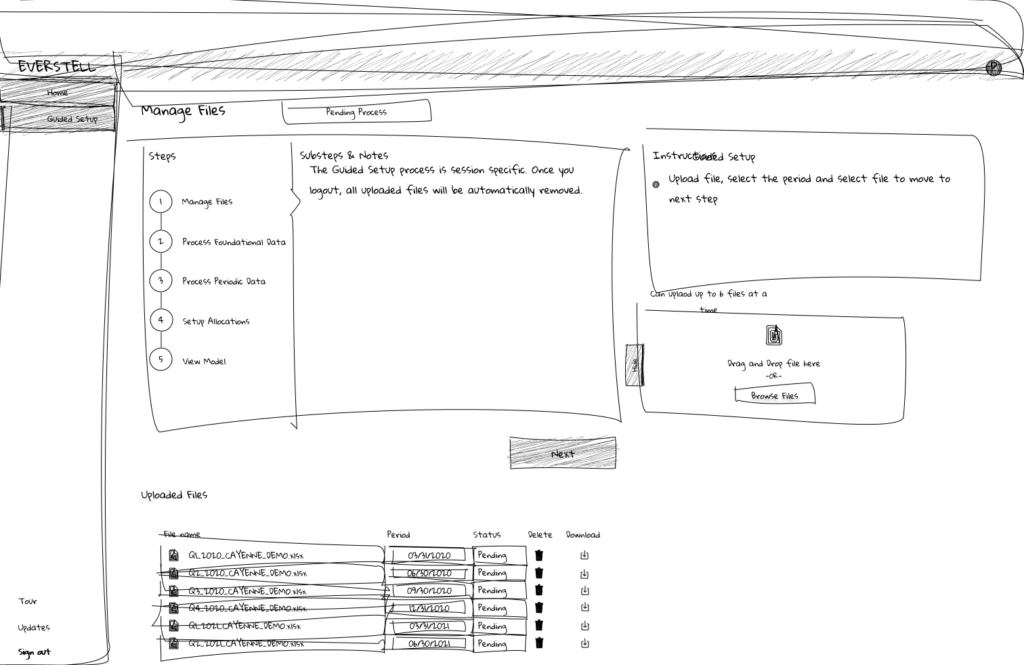
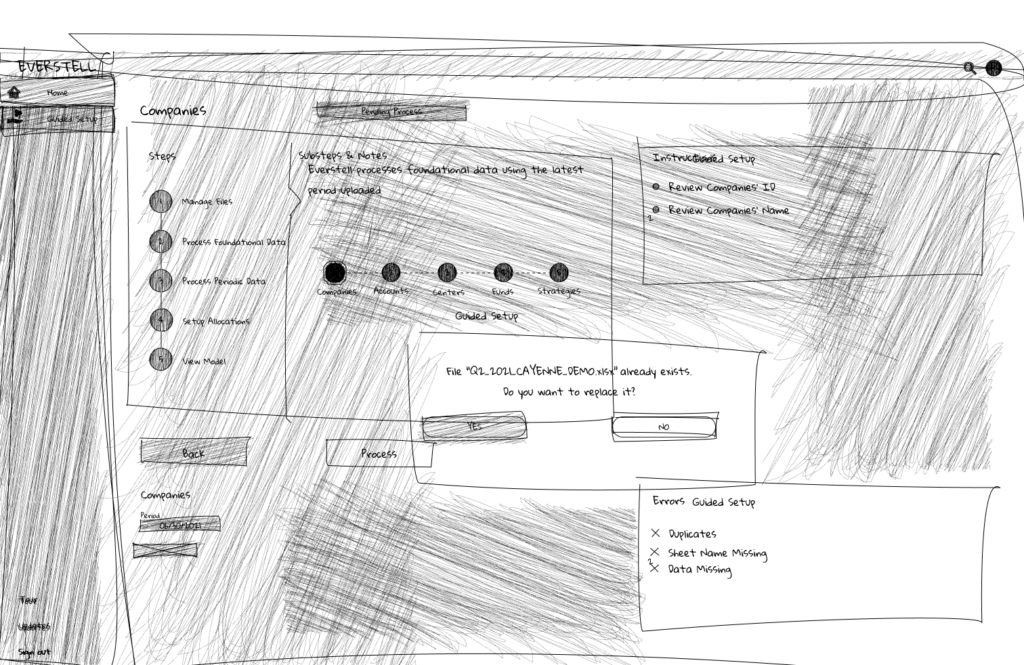
• Early sketches were reviewed with stakeholders and engineers to gather feedback and assess technical feasibility.
• Discussions helped refine the onboarding workflow and validate key interaction patterns.
• Sketching enabled quick alignment across the team before moving into detailed wireframes.
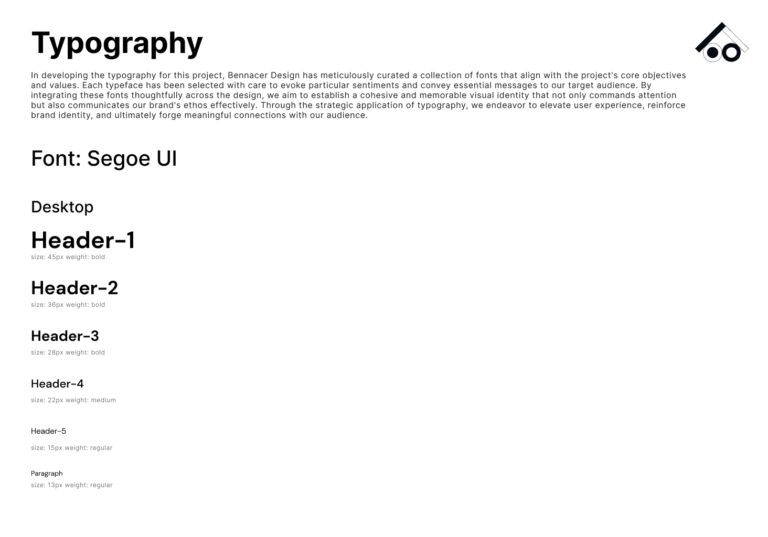
Segoe UI was selected for its clarity and readability in data-dense enterprise interfaces.
Its clean letterforms and balanced spacing ensure financial metrics, labels, and navigation remain easy to scan across complex dashboards and onboarding flows.
The typeface also maintains strong legibility at smaller sizes, supporting tables, validation messages, and detailed financial data throughout the platform.
Introduced distinct entry points for new clients and existing members to align with different user journeys.
Existing members can bypass onboarding and access dashboards and data immediately.
Simplified a fragmented 12-step process into a structured 5-step flow, improving clarity and reducing cognitive load.
Introduced clear progress indicators to guide users through setup and provide visibility into completion.
Created a single source of truth for document uploads, enabling bulk actions (drag-and-drop, edit, delete, replace).
Replaced scattered, repetitive uploads with a unified interaction.
Users can move between steps without restarting, reducing friction during setup.
Reducing drop-off in a previously long and unclear funnel.
through fewer steps and streamlined interactions
Simplifying decision points and workflow structure
Users reach the dashboard more efficiently
Users can move between steps without restarting, reducing friction during setup.
Introduced inline validation to detect errors immediately during document upload and data configuration.
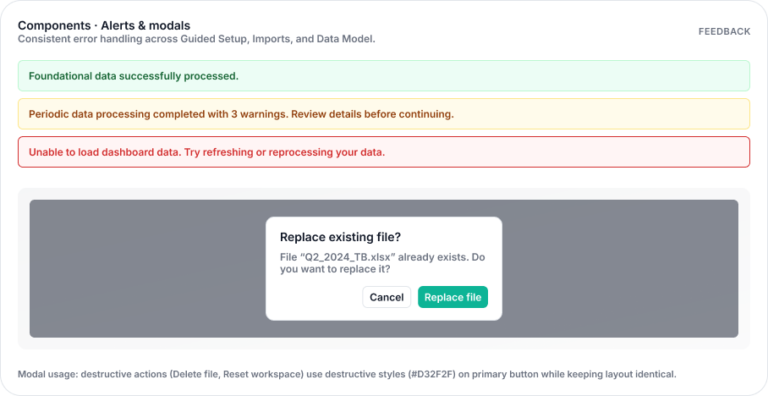
Replaced vague system errors with clear, specific guidance to help users resolve issues quickly.
Users can fix issues directly within the flow without restarting or leaving the onboarding process.
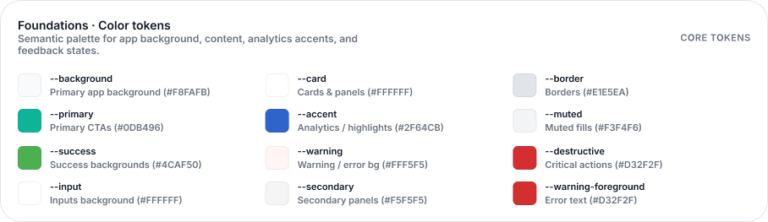
Defined clear success, warning, and error states to improve feedback and reduce uncertainty.
Enabling users to resolve issues independently
Through clearer guidance and feedback
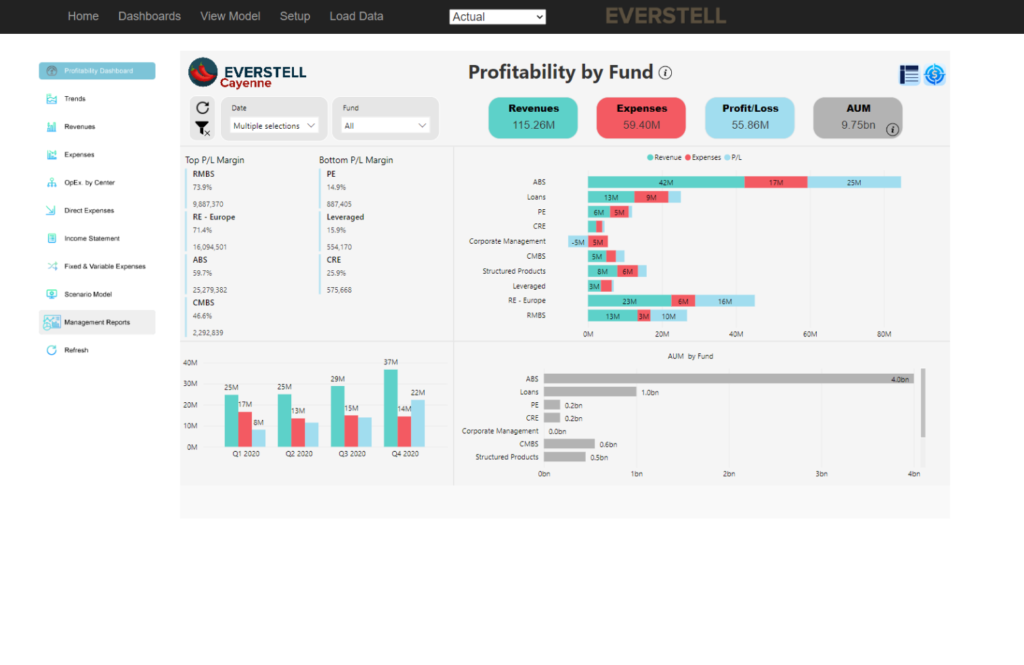
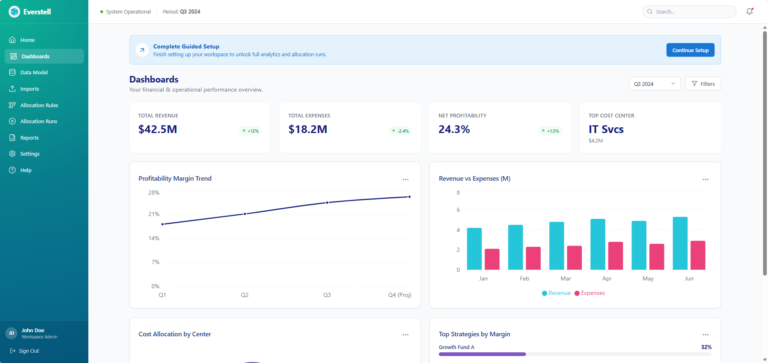
Key metrics such as revenue, expenses, and profitability are surfaced upfront, allowing users to quickly assess financial performance.
Structured layout and typographic hierarchy enable users to interpret complex financial data at a glance.
Charts and graphs provide clear visibility into financial trends over time, supporting faster analysis and decision-making.
Status signals communicate the state of models and data processing, reducing uncertainty.
Enabling users to resolve issues independently
Through clearer guidance and feedback
Mapped designs to implementation tickets (e.g., onboarding shell, file management, validation, dashboard).
Broke down features into buildable phases to support parallel development and faster iteration.
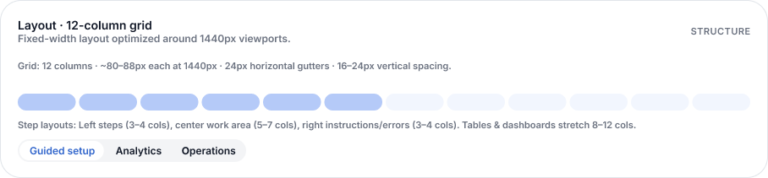
Provided spacing, typography, color tokens, and component dimensions directly in Figma for accurate implementation.
Structured flows by feature (Onboarding, File Management, Dashboard) with final screens and linked components.
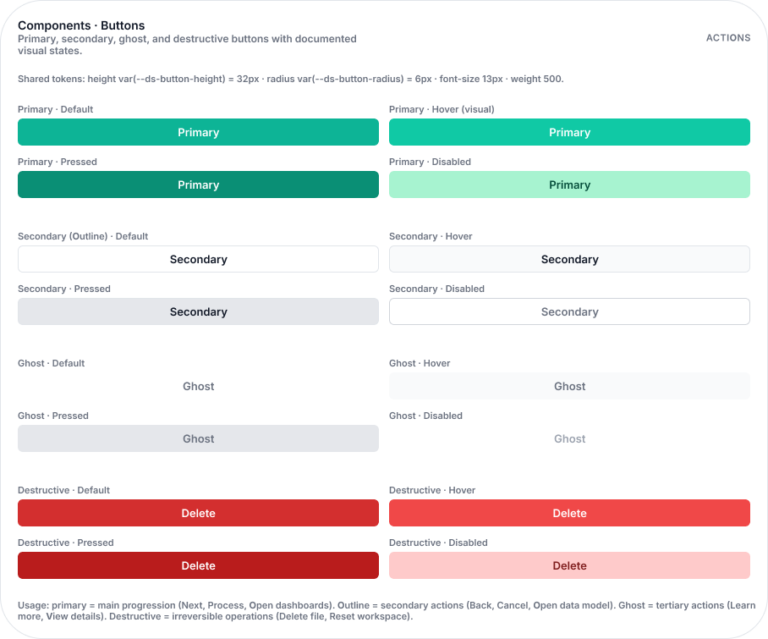
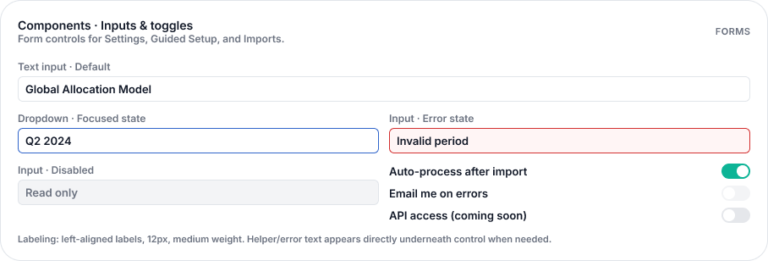
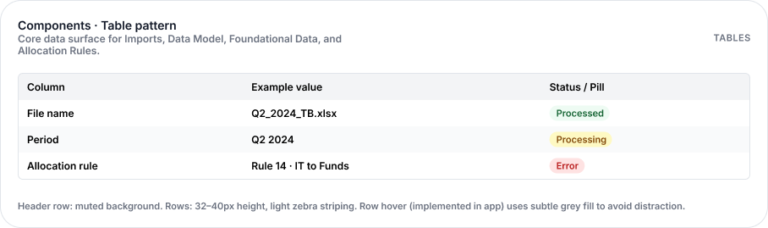
Delivered a component library (buttons, inputs, upload modules, KPI cards) to ensure consistency in build.
Specified states for all key elements (default, hover, active, disabled, loading, error) to remove ambiguity.
Documented key behaviors for onboarding steps, file uploads, and navigation.
Defined rules for errors, success states, and edge cases (e.g., duplicate files, invalid formats, missing data).
Ran sessions with engineers to review flows, clarify interactions, and align on constraints.
Adapted patterns to fit frontend architecture (e.g., navigation structure, component reuse) to reduce complexity.
Reviewed staging builds to ensure visual and interaction accuracy.
Addressed implementation questions, refined details, and adjusted designs based on real constraints.
This approach ensured the designed experience translated accurately into a scalable, maintainable product.
Simplifying the flow from 12 steps to a structured 5-step process significantly reduced drop-off across the onboarding funnel.
Streamlined interactions, bulk uploads, and reduced redundancy enabled faster setup and quicker access to the platform.
Improved feedback systems and centralized file management reduced user mistakes in high-stakes financial workflows.
Users were able to reach dashboards and actionable financial insights faster after completing onboarding.
Clear step progression, better feedback, and improved system visibility increased trust and usability during setup.
Clear validation and in-context guidance allowed users to resolve issues independently, reducing reliance on IT support.
Improved dashboard clarity and data visualization encouraged deeper interaction with financial insights.
The redesign shifted onboarding from a technical bottleneck into a scalable product experience that enables finance teams to move from setup to insight with speed and confidence.
This project reinforced that in enterprise products, the biggest challenges are rarely visual—they are structural.
By focusing on workflow clarity, system feedback, and user control, complex financial processes became significantly more manageable.
The key takeaway:
When systems guide users step-by-step, complexity becomes intuitive.